Feature flags without the tech debt
When a rollout finishes, a GitHub Action opens one reviewable pull request per dead flag and removes the code path in thirteen languages, with no LLM involved. Percentage rollouts, targeting, A/B tests and kill switches come with it, across 13 SDKs. One flat price with nothing metered. No active users, no service connections, no evaluation caps, no overage.
Free forever for up to 3 people. No credit card required.
npm install @featureflip/browser
Running something else? There are 12 more SDKs.
import { FeatureflipClient } from '@featureflip/browser';

const client = FeatureflipClient.get({
  clientKey: 'sdk_client_a1b2c3d4',
});
await client.initialize();

if (client.boolVariation('new-checkout', false)) {
  showNewCheckout();
}
The whole life of a flag
Create it from your editor, ramp it from the dashboard, and let the cleanup Action open the pull request that takes it back out. You review it. The merge archives the flag.
-
Create
agent → featureflip
create_flag("new-checkout")
Created. Disabled in every environment.
Ask your agent for it over MCP, or declare it in Terraform. New flags land disabled in every environment, so nothing moves until you say so. Give it an expiry date on the way in.
-
Ramp
new-checkout 100%
production · percentage rollout
Take the rollout from 10% to 100% in the dashboard, through the API, or by asking the agent. Each change streams to your SDKs over SSE. Nothing redeploys.
-
Detect
production
DeadFully rolled out. One variation to 99.9% of evaluations.
Featureflip reads the evaluation traffic each flag actually receives, hourly, per environment. A signal that holds for 30 days marks the flag stale. At 90 days it is dead. A passed expiry date marks it stale right away.
-
Remove
Remove dead feature flag: new-checkout
featureflip/remove-flag/new-checkout
Merged. Flag archived.
The Action opens one reviewable pull request per dead flag, rewriting the code with AST transforms and no LLM, so the same repository always produces the same diff. Merge it and the flag is archived. Whatever it declines, like a flag read behind your own wrapper, your agent removes over MCP.
When a flag expires or goes dead, its owner gets one cleanup email, or your admins do if nobody owns it. Expiry dates come with every plan, cleanup emails start on Team, and named flag owners start on Pro. Expiry dates, owners and cleanup emails
Ship the flag. Then get it out of your codebase.
Toggle, target, and roll out features from a real-time dashboard built for engineers who ship often.
Staleness signals
-
Fully rolled out
Enabled and serving one variation to 99.9%+ of evaluations.
-
Rolled back
Disabled, with at most one variation served.
-
No traffic
Enabled but receiving zero evaluations.
-
Never used
Created and never evaluated in this environment.
-
Past expiry date
The expiry date set on the flag has passed. Stale right away, no waiting period.
Dead flags leave in a pull request
A GitHub Action opens one reviewable pull request per dead flag, deletes the code path across thirteen languages with no LLM involved, and archives the flag when you merge. The detection behind it needs nothing installed and runs hourly, per environment, from the evaluation traffic each flag actually receives.
resource "featureflip_feature_flag" "new_checkout" {
  project = "web"
  key     = "new-checkout"
  name    = "New Checkout Flow"
  type    = "Boolean"
}

resource "featureflip_flag_environment" "prod" {
  project     = "web"
  flag        = featureflip_feature_flag.new_checkout.key
  environment = "production"
  enabled     = true
}
Manage flags as code
Declare projects, flags, targeting rules, segments, and webhooks in Terraform, then apply them like the rest of your infrastructure. Flag changes get reviewed in a pull request, promote cleanly between environments, and stay reproducible.
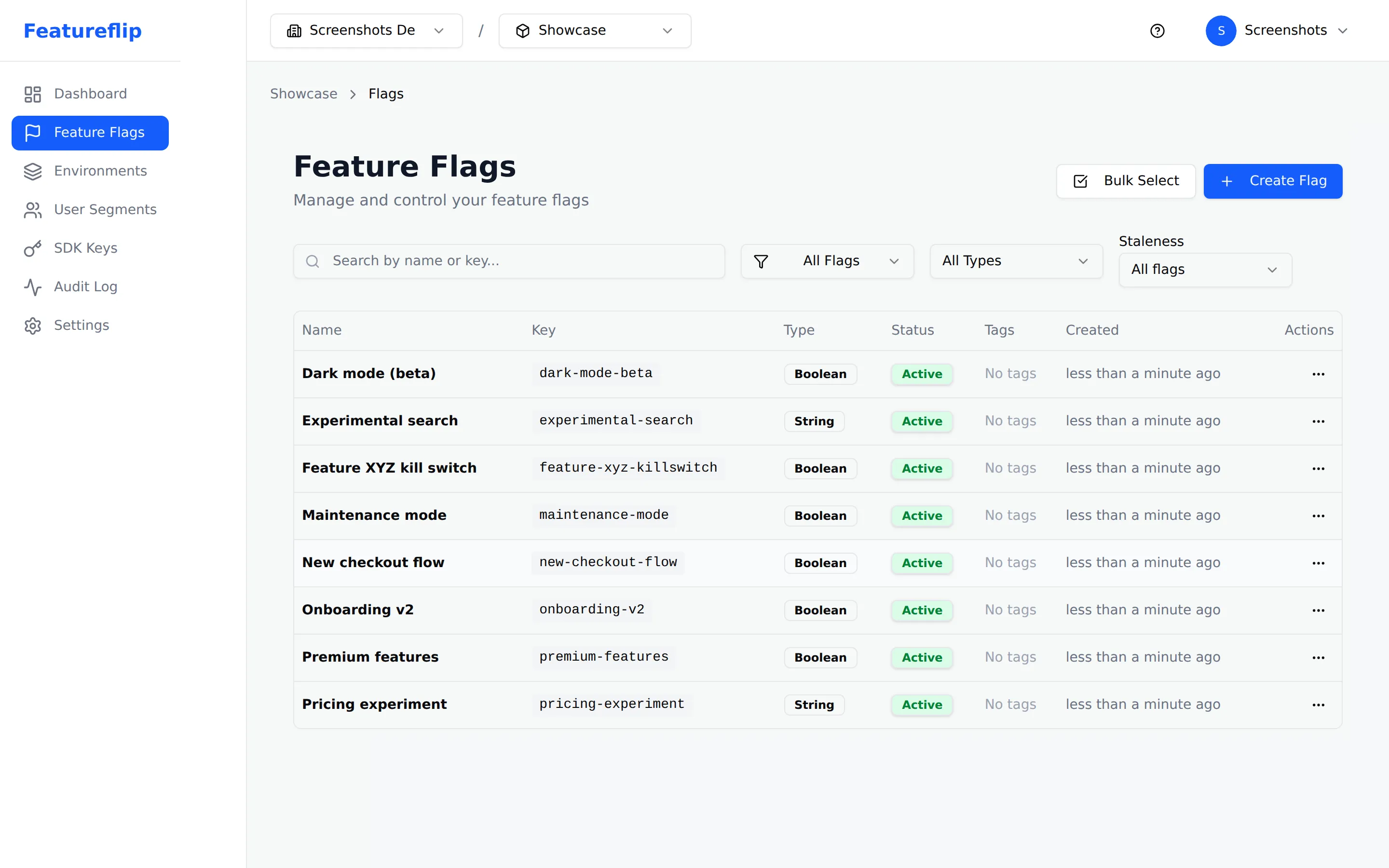
Instant rollouts
Toggle features on or off across every environment in real time. No deployments, no restarts, no waiting — your change is live everywhere within milliseconds.
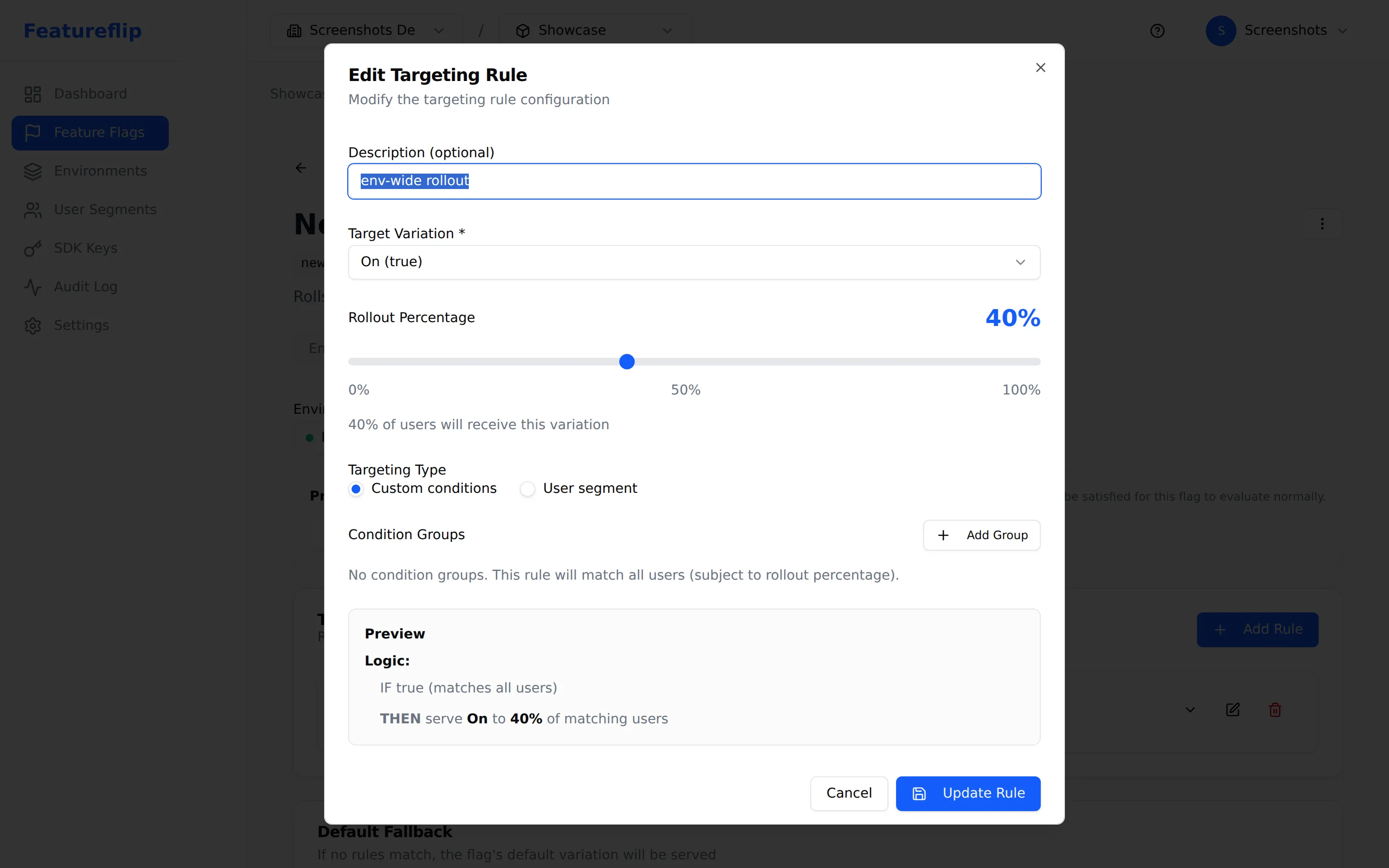
Gradual, percentage-based rollouts
Ship to 1%, then 10%, then 100%. Watch metrics with every step. If anything looks off, roll back by moving the slider — no re-deploy required.
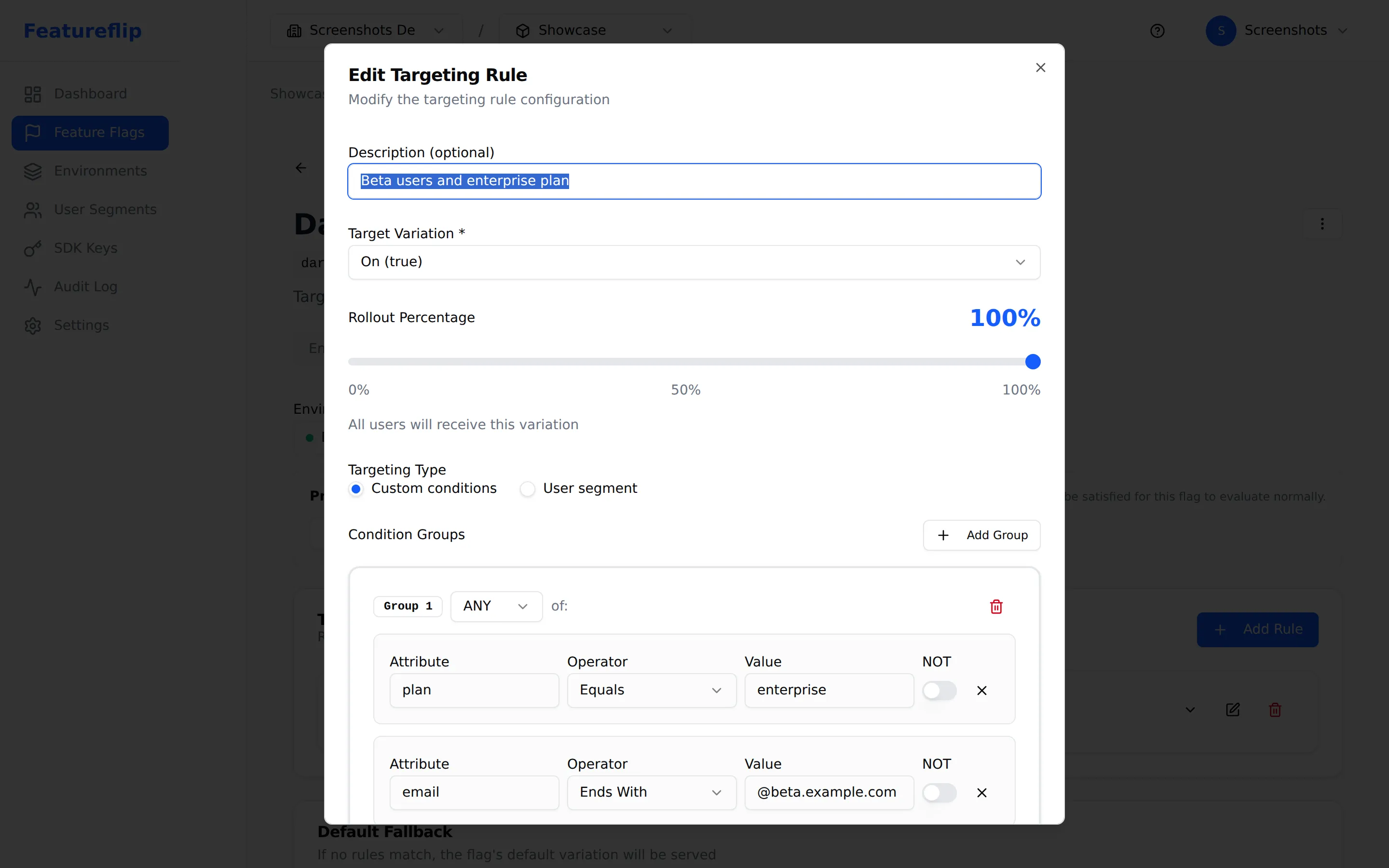
Surgical targeting
Combine attributes, segments, and plan data into AND/OR condition groups. Target by region, plan, cohort, or any custom attribute your app tracks.
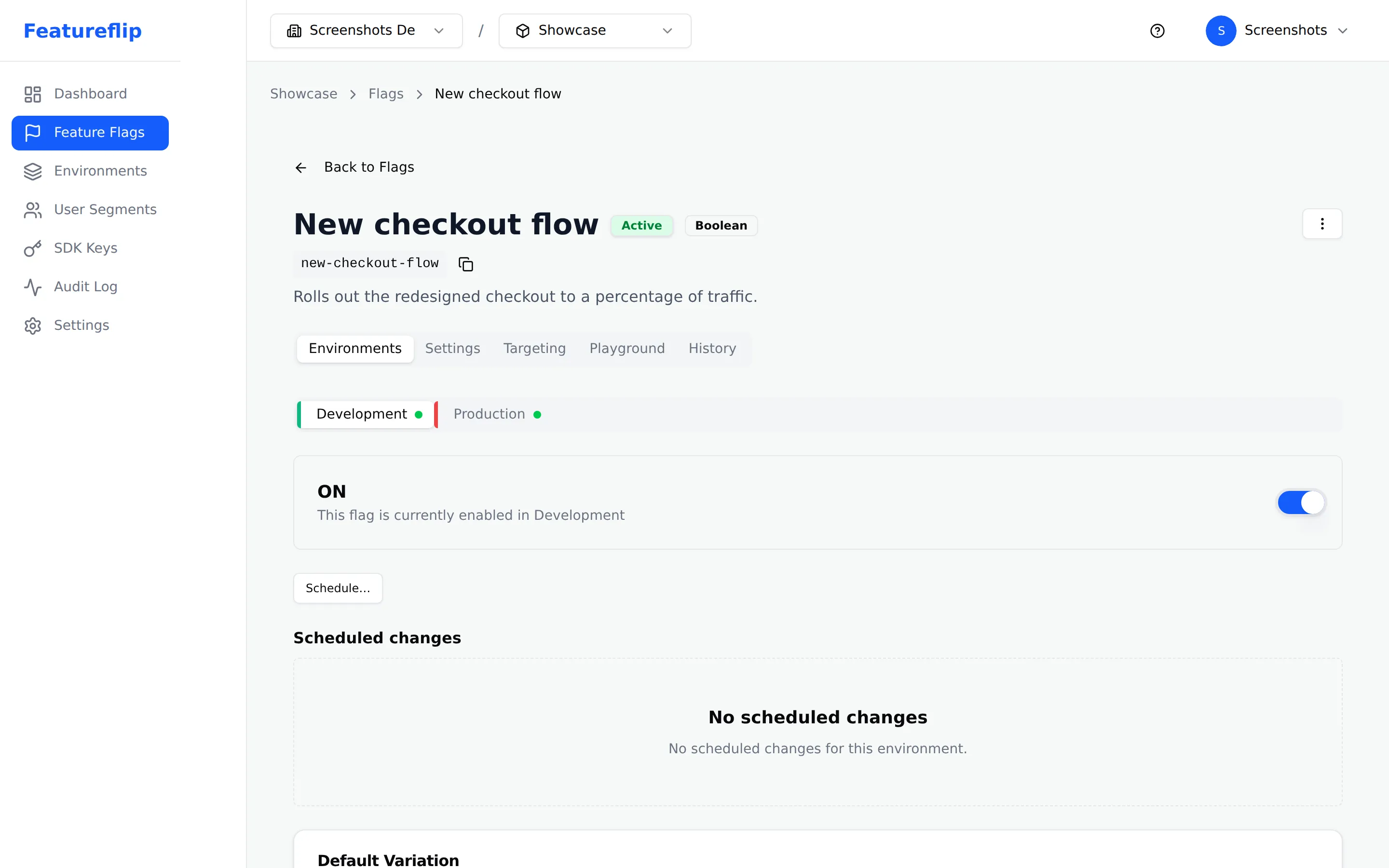
Multi-environment by default
Keep development and production configurations fully isolated. Promote the exact state forward when you are ready — or keep them intentionally different.
Thirteen SDKs, and flag cleanup works with every one.
Drop-in libraries in 13 languages and frameworks. Server SDKs evaluate in process, so a flag check costs a function call and no network round trip, returning in well under a millisecond. Client SDKs stream live updates to the browser.
Because a server SDK reads from an in-memory copy of your configuration, it keeps serving flags when Featureflip is unreachable and re-syncs on its own once we are back. We wrote up what separates an SDK that recovers from one that needs a restart.
Prefer a vendor-neutral API? Featureflip also ships OpenFeature providers for Node.js, .NET, Python, Go, Java, PHP and Ruby.
How much does Featureflip cost?
Start free, scale as you grow.
Every plan includes percentage rollouts, targeting rules, kill switches, all 13 SDKs, the Management API, the Terraform provider, and flag expiry dates. Paid plans add scheduled changes and cleanup emails, Pro adds flag owners, and Business adds single sign-on through your own identity provider. Beyond that, plans differ only in scale.
Free
Free forever, and built to run in production
- 10 flags per project
- 2 environments per project
- 1 project
- Up to 3 team members
- Flag expiry dates
- 7-day audit logs
- 1 webhook endpoint
- Management API access
- Community support
Team
billed annually
For small teams shipping features together
- Unlimited flags
- 3 environments per project
- 3 projects
- Up to 5 team members
- Scheduled changes
- Flag expiry dates
- Flag cleanup emails
- 30-day audit logs
- 3 webhook endpoints
- Management API access
- Email support
Pro
billed annually
For teams running several products
- Unlimited flags
- 5 environments per project
- 10 projects
- Up to 10 team members
- Scheduled changes
- Flag expiry dates
- Flag cleanup emails
- Flag owners
- 30-day audit logs
- 3 webhook endpoints
- Management API access
- Email support
Business
billed annually
For growing organizations that need more room
- Unlimited flags
- Unlimited environments
- 25 projects
- Up to 25 team members
- Scheduled changes
- Flag expiry dates
- Flag cleanup emails
- Flag owners
- SSO with your identity provider (OIDC)
- 90-day audit logs
- Unlimited webhook endpoints
- Management API access
- Priority support
Need more? Contact us for Enterprise pricing.
Already using LaunchDarkly? Featureflip is flat per plan, with nothing metered: no charge for active users, service connections, evaluation volume, or overage. Put your own numbers through the LaunchDarkly cost calculator to see what that changes, or read the full comparison on pricing math, feature parity, and migration.
Moving off Flagsmith or ConfigCat instead? The guides to Flagsmith alternatives and ConfigCat alternatives walk through choosing a replacement for each.
Frequently asked questions
- What are feature flags?
- Feature flags (also called feature toggles) let you turn functionality on or off in a running application without deploying new code. That decouples deploy from release: you can merge to production with a feature switched off, then turn it on for 1% of users, expand to everyone, serve a different variation to one cohort for an A/B test, or kill it the moment a metric moves the wrong way. No rebuild, and the change reaches your SDKs in seconds.
- Is Featureflip free to use?
- Yes! The Free plan is free forever and includes 1 project, 10 flags, and 2 environments. Paid plans start at $49/month ($39/month billed annually) for teams that need more projects, members, and advanced features.
- What programming languages are supported?
- Featureflip provides official server-side SDKs for JavaScript/TypeScript, Node.js, Python, C#, Java, Go, PHP, and Ruby, plus client-side SDKs for React, Browser, Swift, Flutter, and Android. You can also integrate directly with the Evaluation API using any HTTP client.
- How is Featureflip different from other feature flag platforms?
- Featureflip closes the loop on a flag. Once a flag is finished, a GitHub Action opens one reviewable pull request per dead flag, removes the code path in thirteen languages with no LLM involved, and archives the flag when you merge. The price is flat per plan and nothing is metered, so there is no charge for active users, service connections, evaluation volume, or overage. Percentage rollouts, targeting, kill switches, and all 13 SDKs are included at every tier, including the Free plan, which is meant to run in production rather than expire after a trial.
- Can I manage feature flags through an API?
- Yes. The Management API exposes everything the dashboard does over REST: create and toggle flags, manage environments, targeting rules, segments, and SDK keys. It is included on every plan, changes stream to your SDKs live, and every API change is recorded in the audit log. Webhook subscriptions live in the same API, so your deploy pipeline or chat channel can get a signed request the moment a flag changes.
- What happens to my app if Featureflip goes down?
- It keeps serving flags. Server SDKs hold your flag configuration in memory and evaluate it inside your own process, so a flag check never waits on a call to us. If Featureflip becomes unreachable, the SDK carries on evaluating against the last configuration it received, and any flag it cannot resolve returns the default you passed at the call site. It also reconnects on its own, retrying with capped exponential backoff and dropping to polling when a stream will not hold. Every reconnect pulls a full configuration snapshot, so a flag you changed during the gap gets picked up without anyone restarting a process.
Ship your first flag in about five minutes
Create a flag, drop in the SDK for your stack, and toggle it live. One flat price when you outgrow the free plan, whatever your team size or traffic.
Free forever for up to 3 people. No credit card required.